
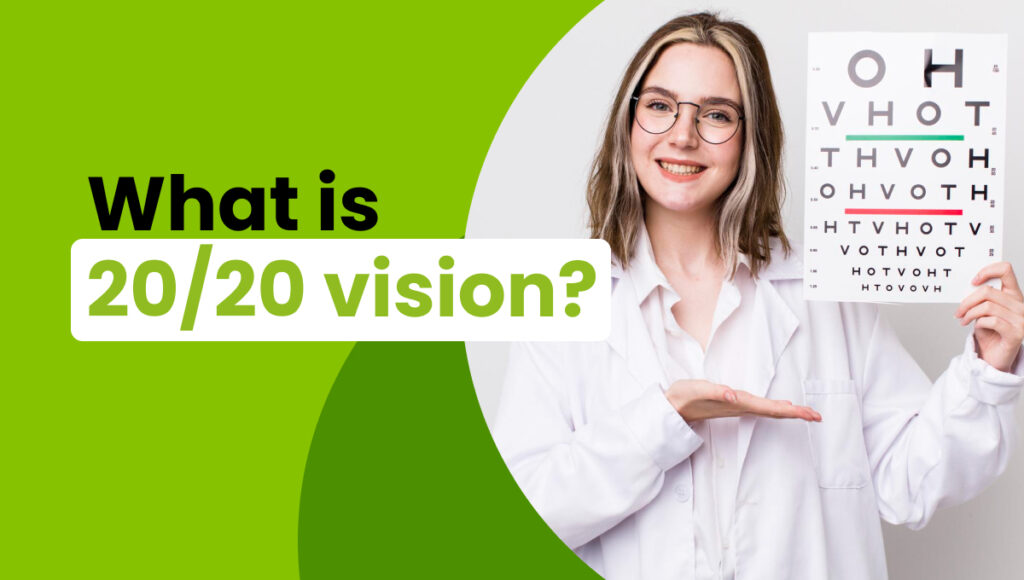
You sit down in the optometrist’s chair, read the letters, and get told your vision is 20/20. You leave feeling reassured. And for many people, that reassurance is the last time they think about their eye health for years.
The problem is that 20/20 is not a report card on the health of your eyes. It is a single measurement of one specific thing: how sharply you can see a standard letter chart at a set distance. It says nothing about your peripheral vision, your eye health, your night vision, or a range of conditions that can cause serious damage long before they affect that chart result.
Understanding the real 20/20 vision meaning is one of the most useful things you can know about your own eye care. Because knowing what it does and does not tell you is what helps you make the right decisions about when and how often to have your eyes properly examined.
The Patient Who Passed Every Test and Still Could Not Drive at Night
At Clear Vision Optical, we see a version of this situation regularly. A patient comes in, not because they have noticed anything dramatic with their vision, but because something feels slightly off in a way they cannot quite name.
One patient arrived recently after years of being told his eyesight was excellent. He could read the chart with no difficulty. His distance vision was sharp. But over the past eighteen months, driving after dark had become increasingly uncomfortable. Headlights from oncoming cars produced a halo effect that was hard to ignore, and he had started avoiding the motorway at night without quite admitting to himself why.
His chart result was still perfectly clear. But a comprehensive eye test for vision clarity that went beyond the standard letter chart revealed the early signs of a cataract developing in one eye. It was not yet affecting his daytime sharpness. It was, however, directly responsible for how he experienced light after dark.
He had been walking around with a developing eye condition for the better part of two years, reassured each time by a result that was never designed to catch it. His story is more common than most people expect, and it is exactly why what is 20/20 vision is a question worth answering properly.
What Is 20/20 Vision, Exactly?
The term comes from a measurement system developed in the nineteenth century by Dutch ophthalmologist Herman Snellen. The first number refers to the distance at which you are tested (20 feet, or roughly six metres). The second number refers to the distance at which a person with normal vision can read the same line on the chart.
So 20/20 means you can see at 20 feet what a person with standard vision sees at 20 feet. In Australia, the same measurement is often expressed as 6/6, using metres rather than feet. The two are equivalent. If your result is 20/40, it means you need to stand at 20 feet to read what someone with normal vision can read at 40 feet.
That is the full 20/20 vision meaning: a ratio that describes your distance sharpness relative to a statistical norm. It is a useful benchmark. It is not a measure of overall eye health.
What Visual Acuity Measures (And What It Does Not)
Visual acuity is the technical term for what the Snellen chart measures: the sharpness of your central, distance vision under good lighting conditions. It is the most commonly referenced figure in eye care because it is quick to measure, standardised, and easy to communicate.
But visual acuity is one component of vision, not the whole picture. A 20/20 result tells you nothing about:
- Peripheral vision — which can narrow significantly with glaucoma before central sharpness is affected at all
- Night vision and contrast sensitivity — which can deteriorate with early cataracts or nutritional deficiencies
- Binocular vision — whether your two eyes are working together smoothly and efficiently
- Colour vision — which can be affected by macular conditions and certain medications
- Eye pressure — a key indicator for glaucoma, which causes no noticeable symptoms in its early stages
- The health of the retina, optic nerve, and internal eye structures
Glaucoma affects an estimated 300,000 Australians and is one of the leading causes of preventable blindness in this country. Most people who have it in its early stages would read a 20/20 chart without difficulty. This is precisely why relying on visual acuity alone as a measure of eye health creates a significant blind spot in your care.
What a Comprehensive Eye Test for Vision Clarity Actually Checks
A thorough eye test for vision clarity at Clear Vision Optical is designed to examine your entire visual system, not just how sharply you read a chart. It includes assessments that a routine screen will not cover.
Your optometrist will check your prescription across different distances, examine how your eyes move and focus together, assess your peripheral vision, measure your eye pressure, and examine the health of the structures inside your eye. In some cases, digital retinal imaging is used to photograph the back of the eye, producing a detailed record that allows any changes to be tracked over time.
This kind of comprehensive examination is the difference between knowing your visual acuity and actually understanding the state of your eye health. The two are related, but they are not the same thing.
Can You Have 20/20 Vision and Still Need Glasses?
Yes, and this surprises many people. You can have sharp distance vision and still benefit from glasses for reading, close work, or extended screen use. Presbyopia, the gradual loss of near focusing ability that typically begins in the mid-forties, does not necessarily affect distance sharpness at all. Many people with excellent distance visual acuity wear reading glasses daily.
Similarly, someone with 20/20 distance vision can have a significant astigmatism that causes distortion in specific lighting conditions, or a binocular vision issue that produces fatigue and headaches without ever touching their chart result.
The short answer to what is 20/20 vision in practical terms is this: it is a useful reference point, not a diagnosis. It tells you how clearly you see at distance under ideal conditions. It does not tell you whether your eyes are healthy, whether they are working efficiently together, or whether there is something developing inside them that needs attention.
Two More Situations That Illustrate the Point
The night-driving story is one example. These two reflect what we see regularly in practice.
A ten-year-old who read the chart perfectly but could not read a book. His parents brought him in after his teacher flagged ongoing difficulties with sustained reading. He had passed every school vision screening without issue. His distance visual acuity was fine. But a comprehensive examination revealed convergence insufficiency, a condition where the eyes struggle to work together during close tasks. The chart test had told us nothing about this, because it was not designed to. With targeted treatment, his reading comfort improved significantly within a few months.
A woman in her early fifties who assumed 20/20 meant no glasses needed. She came in after months of afternoon headaches and increasing difficulty with her phone screen. She had not had a full examination in years because she had always been told her eyesight was sharp. A comprehensive eye test for vision clarity confirmed her distance vision was still strong, but she had developed moderate presbyopia affecting near focus. She had been straining her eyes every time she looked at a screen or read a menu, and the headaches were a direct result. A simple reading prescription resolved them within a week.
The Takeaway
Twenty-twenty is a number worth knowing. It is also worth knowing what it does not cover. Sharp distance vision is a good sign, but it is one data point in a much larger picture of eye health, and conditions like glaucoma, cataracts, and macular degeneration can develop quietly for years without ever registering on a letter chart.
A comprehensive examination that goes beyond visual acuity is what gives you the full picture. Adults should have one at least every two years, and annually if they are over fifty, have a family history of eye disease, or have diabetes or another condition that affects the eyes.
If the last time someone assessed your eye health was the last time you read a chart, it is worth booking something more thorough. Understanding what is 20/20 vision means understanding what it cannot tell you, and that gap is exactly what a full eye examination at Clear Vision Optical is designed to fill.
The Takeaway
Twenty-twenty is a number worth knowing. It is also worth knowing what it does not cover. Sharp distance vision is a good sign, but it is one data point in a much larger picture of eye health, and conditions like glaucoma, cataracts, and macular degeneration can develop quietly for years without ever registering on a letter chart.
A comprehensive examination that goes beyond visual acuity is what gives you the full picture. Adults should have one at least every two years, and annually if they are over fifty, have a family history of eye disease, or have diabetes or another condition that affects the eyes.
If the last time someone assessed your eye health was the last time you read a chart, it is worth booking something more thorough. Understanding what is 20/20 vision means understanding what it cannot tell you, and that gap is exactly what a full eye examination at Clear Vision Optical is designed to fill.
Frequently Asked Questions
What is 20/20 vision?
20/20 vision is a measure of visual acuity, or how clearly you can see a standardised letter chart at a distance of 20 feet (roughly six metres). It indicates that your distance sharpness matches what is considered normal. In Australia, the equivalent metric measurement is 6/6. It does not measure eye health, peripheral vision, night vision, or binocular coordination.
Is 20/20 vision the same as perfect vision?
No. 20/20 is a benchmark for normal distance acuity, not a measure of overall visual health. You can have 20/20 vision and still have glaucoma, early cataracts, convergence problems, or a condition affecting your peripheral or night vision. A comprehensive eye test for vision clarity examines aspects of your visual system that the chart test is not designed to assess.
What does the 20/20 vision meaning actually tell us about eye health?
The 20/20 vision meaning is specific and limited: it describes how sharply you see at distance under standard conditions. It does not reflect the health of your retina, optic nerve, or internal eye structures. Eye disease can progress significantly before it has any impact on a letter chart result, which is why regular comprehensive examinations are essential regardless of your acuity score.
How often should I have a full eye test?
Adults should have a comprehensive eye examination at least every two years. Those over 50, or with a family history of glaucoma or macular degeneration, should consider annual testing. Children should be tested before starting school and regularly throughout their schooling years, as vision problems that do not affect distance acuity can still significantly impact learning.
